

Table of Contents
- Why Comfortable Gear for K9 Handlers Decides the Shift
- K9 Handler Boots: Ankle Support and Terrain Navigation
- K9 Handler Clothing That Survives Field Deployment
- K9 Handler Equipment: Harnesses, Leashes, and Restraint
- Working Dog PPE: Booties, Eye Protection, and Bite Gear
- Ergonomic Load Carriage and Climate-Specific Layering
- The K9 Handler Gear Checklist for Every Deployment
- Conclusion: Gear That Keeps You and Your Dog Operational
- Frequently Asked Questions
Last Updated: October 5, 2026
Why Comfortable Gear for K9 Handlers Decides the Shift
A K9 handler's shift doesn't end when the call does. It ends when the dog is fed, kenneled, and the handler finally sits down. Comfortable gear for k9 handlers is the difference between finishing that shift functional and finishing it wrecked.
The core tension most gear guides miss? K9 handler equipment is usually built for the dog's needs first and the human's second. That's backwards. A handler who's limping from bad boots or fighting a harness that chafes can't read their dog, can't move quietly, and can't sustain a long search.
Below, we'll walk through each gear category, what to look for, and where handlers commonly overspend or underspend.
K9 Handler Boots: Ankle Support and Terrain Navigation
The best K9 handler boots prioritize ankle support and traction over lightweight styling. A mid-to-high cut with a stiff heel counter keeps the ankle stable on uneven ground, which is where most handler injuries start.
Look for these features:
- Ankle support: Mid or high cut with a padded collar and firm heel counter
- Traction: Lugged rubber outsole that grips gravel, mud, and wet grass
- Waterproofing: Breathable membrane, since feet sweat on long deployments
- Break-in time: Leather boots take longer but last; synthetic uppers break in faster
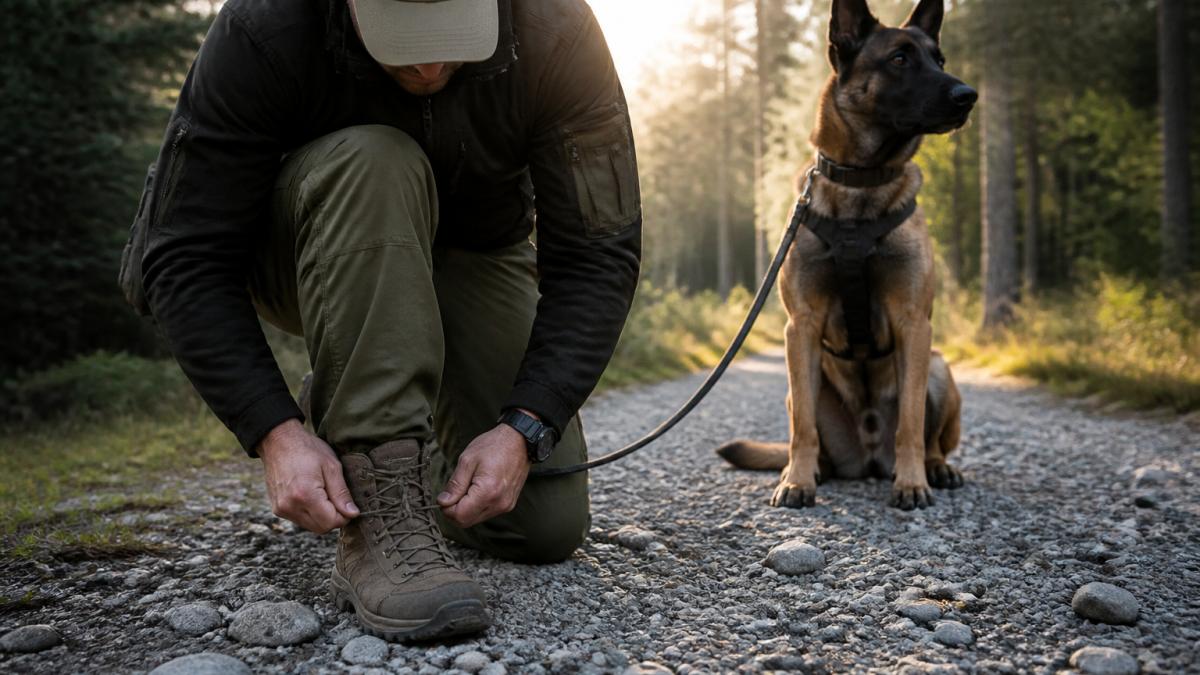
A common mistake is buying boots sized for a thick sock and then wearing thin socks on a warm deployment. Fit changes with sock thickness. Get fitted with the socks you actually wear.
K9 Handler Clothing That Survives Field Deployment
Durable materials and breathable mesh matter more than camouflage pattern. K9 handler clothing takes abuse: brush, brambles, vehicle seats, and repeated washing. Reinforced knees and elbows extend the life of any pant or shirt considerably.
What to prioritize:
- Fabric: Ripstop or heavyweight cotton blends that resist tearing
- Ventilation: Breathable mesh panels under the arms and behind the knees
- Fit: Snug-fitting but not restrictive, so it doesn't snag on gear
- Layers: A base layer that wicks, a mid layer that insulates, an outer shell that blocks wind
For handlers who want their off-duty identity to match the job, our German Shepard Happy 250th America T-Shirt is built from 100% ring-spun cotton with a modern unisex fit. It's soft enough for the ride home and tough enough for the yard.

K9 Handler Equipment: Harnesses, Leashes, and Restraint
A modular system beats a fixed one, every time. K9 handler equipment works best when it adapts: a tactical harness with MOLLE-compatible panels, a quick-release buckle for safety, and a tactical leash with a traffic handle for close control.
| Gear Item | Key Feature | Best For |
|---|---|---|
| Tactical harness | MOLLE panels, padded chest | Long tracks, load-bearing |
| Tactical leash | Traffic handle, quick-release | Urban and vehicle work |
| Restraint system | Adjustable, low-profile | Training and transport |
The thing nobody tells you about restraint gear: cheaper hardware fails at the worst moment. A quick-release that jams under load is worse than no quick-release at all.
Working Dog PPE: Booties, Eye Protection, and Bite Gear
Working dog PPE protects the dog first, but it also protects the handler's control.
Dog booties. The failure mode is almost always sizing, not materials.
- Hot pavement: Thin, breathable, high-contrast sole so you can see wear; check paw pads after every block
- Ice and snow: Insulated cuff, lugged sole, and a strap that won't stiffen in cold
- Rock and debris: Abrasion-resistant toe cap and a sole that flexes with the paw
- Wet grass and mud: Drainage holes or a quick-dry liner, or the bootie becomes a water cup
Eye protection. Low-profile goggles and visors keep brush, dust, and debris out of the dog's eyes during a track, but the fit has to clear the muzzle and the brow without pressing on the eyes.
Bite gear. Bite sleeves and bite suits belong to training, and they need to fit the dog correctly or the work suffers.
The unique angle most gear lists skip: PPE is a two-sided comfort system.
Ergonomic Load Carriage and Climate-Specific Layering
Ergonomic design in load carriage is the angle most gear lists ignore entirely. Weight distribution across the shoulders and hips, not just the shoulders, reduces handler fatigue on long deployments. A load-bearing vest with a wide, padded waist belt transfers weight to the hips where it belongs.
German Shepard Happy 250th America T-Shirt →
Climate-specific layering changes the equation further:
- Hot and humid: Moisture-wicking base layer, minimal coverage, breathable mesh
- Cold and wet: Insulating mid layer, waterproof shell, insulated gloves
- Mixed seasons: Modular layers you can shed or add mid-shift
The K9 Handler Gear Checklist for Every Deployment
A repeatable K9 handler gear checklist prevents the two failures that ruin deployments: forgotten gear and gear that fails because it wasn't maintained. Build the list once, then check it every time.
Pre-deployment check
- Boots inspected for sole wear, lace condition, and heel-counter integrity
- Harness and leash hardware tested for function, including the quick-release under load
- Dog booties sized to each paw and packed with the correct liners
- Eye protection cleaned, strap adjusted, and packed
- Base layer, mid layer, and shell packed for the actual forecast, not the season
- First aid kit stocked for handler and dog, with expired items replaced
- Skin cleanser and paw balm packed
Post-shift maintenance and hygiene
The comfort problem handlers talk about least is the one that builds up over weeks: salt, sweat, and grime in the gear that touches skin.
- After every shift: Wipe down hardware with a damp cloth and dry it before storage. Salt and sweat left on buckles and D-rings is what makes them stiff and gritty.
- Weekly: Wash base layers and any fabric that contacts skin. Use a gentle, residue-free detergent and skip fabric softener, which coats technical fabrics and kills wicking.
- Monthly: Inspect stitching on harnesses, leashes, and bite gear. Re-treat leather boots with a conditioner matched to the leather type, and check waterproof membranes for delamination.
- Seasonally: Deep-clean load-bearing vests and packs, re-check all adjustment points, and retire anything with frayed webbing or cracked hardware.
For the dog, the same logic applies. Paw balm after hot or salted surfaces, a rinse after mud or chemical exposure, and a check of the coat under the harness and vest for hot spots.
canine first aid and preventive care guidance for working dogs
Conclusion: Gear That Keeps You and Your Dog Operational
The hardest part of this job isn't the track or the search. It's staying functional shift after shift, deployment after deployment, without your gear working against you. That means boots that support, clothing that survives, and equipment that adapts to the terrain and the climate you're actually working in.
FUR MISSILE builds bold, high-quality apparel for handlers and working dog owners who take that seriously. Our gear uses premium, high-performance materials, features unique pet-inspired designs, and is printed and shipped in the USA with tracking on every order. Start with our Trust The Dog T-Shirt, then build your kit from there.

Frequently Asked Questions
What do K9 handlers wear on a typical shift?
Most handlers build their kit around a few core pieces: moisture-wicking K9 handler clothing, a load-bearing belt or harness, supportive K9 handler boots, and a quick-release tactical leash. The clothing should be snug-fitting but allow shoulder movement, and the harness should distribute weight across the torso rather than one shoulder. Add low-profile eye protection and a small field kit with skin cleanser and first aid supplies. The goal is comfortable gear that holds up through repeated wash cycles and long hours in the field.
What features should K9 handlers look for in tactical clothing?
Prioritize durable materials, breathable mesh panels, and a cut that allows full shoulder movement without riding up. Look for quick-release closures on any belt or harness, MOLLE-compatible webbing if you carry pouches, and a fit that stays snug without restricting your stride. For a base layer, 100% ring-spun cotton shirts like Fur Missile's Training In Progress T-Shirt ($29.99) stay soft through repeated washes, which matters when your dog sheds on everything. Avoid anything that bunches under a load-bearing vest.
How should K9 handlers choose boots for different terrain?
Match the boot to the surface you work most. Ankle support and a stiff shank help on uneven ground and rubble, while a lighter, breathable boot works better for long patrols on pavement. Waterproofing matters in wet grass or snow, but it traps heat in summer, so many handlers rotate two pairs. Break boots in before a field deployment, and replace them once the midsole compresses, usually every 6 to 12 months for full-time handlers. Your dog's booties follow the same logic: terrain-specific, snug, and checked before every deployment.
What gear do K9 handlers need for training and fieldwork?
A practical K9 handler gear checklist covers four areas: handler gear (boots, clothing, load-bearing harness, eye protection), canine gear (tactical harness, collar and leash system, dog booties, bite sleeve or bite suit for training), field support (first aid kit, skin cleanser, water, waste bags), and maintenance items (spare buckles, cleaning cloths, repair kit). Keep a duplicate set in your vehicle so a wet or damaged item never takes you off the schedule. Restraint equipment should be quick-release and tested before each deployment.
How can K9 handlers reduce fatigue on long shifts?
Weight distribution is the biggest lever. A load-bearing harness or belt that spreads weight across your hips and torso cuts shoulder strain compared with a single-strap bag. Keep the load light, reposition pouches so the heaviest items sit close to your body, and use a low-profile design that does not catch on brush. Footwear matters too: supportive boots with good ankle support reduce the small corrections your legs make all day, which adds up. Rotate tasks and take micro-breaks when the dog is resting.
What is a good gift for a K9 handler?
Useful gifts beat novelty every time. A durable T-shirt with a breed-specific design, like Fur Missile's Belgian Malinois Happy 250th America T-Shirt or Trust The Dog T-Shirt (both $29.99), works for off-duty wear and holds up to constant washing. Pair it with a small field item: a compact first aid pouch, a quality carabiner, or a spare tactical leash. Handlers appreciate gear that survives the job. If you are unsure of sizes, a unisex fit in a standard size is the safest choice.
How should K9 handlers choose clothing for different weather conditions?
Layer for the mission, not the forecast. Start with a moisture-wicking base layer, add an insulating mid-layer for cold mornings, and finish with a wind- or water-resistant shell that does not restrict shoulder movement. In heat, switch to breathable mesh and lighter colors, and carry extra water for both you and the dog. In cold, protect extremities first: hands, ears, and feet lose heat fastest. Your dog needs the same logic, which is why dog booties and a climate-appropriate harness matter in snow, ice, or hot pavement.
How do you keep K9 handler gear clean and serviceable long term?
Wash clothing inside out in cold water and air dry when possible to protect prints and seams. Wipe harnesses, leashes, and collars with a damp cloth and mild skin cleanser, then check buckles, stitching, and quick-release mechanisms for wear. Inspect boots for sole separation and replace insoles regularly. For the dog, clean booties and harness pads after muddy deployments to prevent skin irritation. A simple monthly inspection catches small failures before they become field problems, and it keeps your comfortable gear comfortable for years.