

Table of Contents
- Why Waterproof Hunting Apparel Loses Its Edge
- Signs Your Gear Needs Re-Waterproofing
- How to Wash Waterproof Hunting Jackets Without Ruining Them
- Reactivating DWR Coating on Hunting Apparel
- Best DWR Spray for Hunting Gear: What to Look For
- Field Maintenance and Gear Repair Between Washes
- Off-Season Storage and Scent Control for Trainers
- Conclusion
- Frequently Asked Questions
Last Updated: September 21, 2026
Why Waterproof Hunting Apparel Loses Its Edge
Waterproof hunting apparel fails for one main reason: the durable water repellent coating wears off. That coating, called DWR, is what makes water bead up and roll off your jacket instead of soaking in. Every branch you push through, every briar patch, and every wash cycle slowly strips it away.
Signs Your Gear Needs Re-Waterproofing
The clearest sign is water that stops beading. When rain hits a healthy DWR coating, it forms beads and rolls off. When the coating is worn, water spreads out flat and darkens the fabric.
Watch for these signals:
- Water soaks in instead of beading up
- The fabric feels heavy and cold when wet
- The outer shell looks "wet out" across large patches
- Your jacket feels clammy inside, even when it isn't leaking
- Stains and dirt cling to the surface after washing
How to Wash Waterproof Hunting Jackets Without Ruining Them
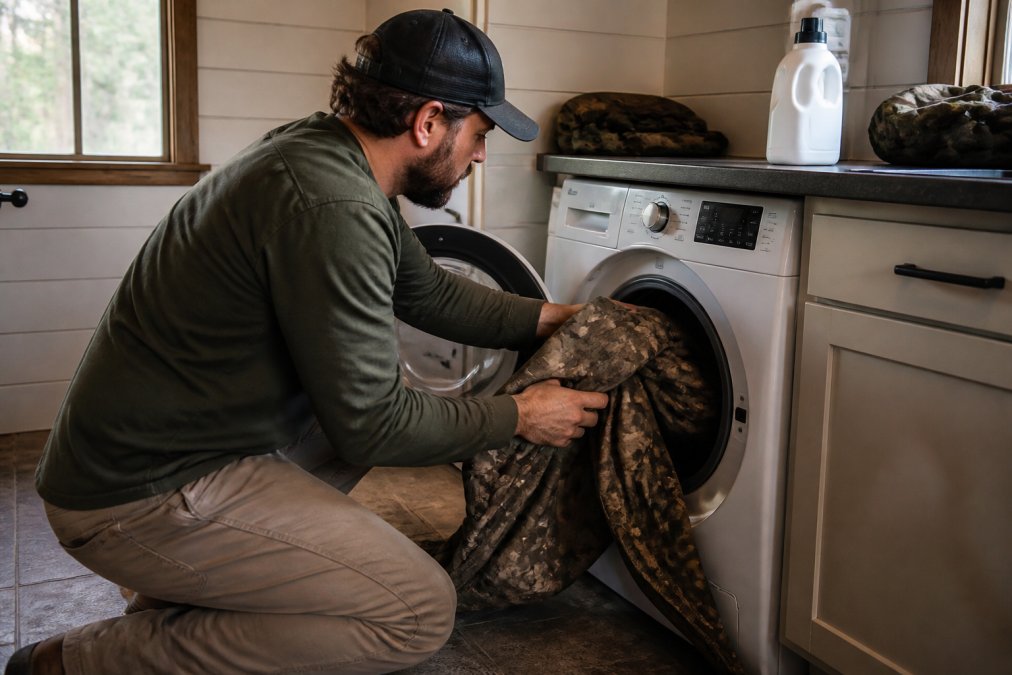
You can wash most waterproof hunting jackets at home, but the method matters more than the machine. Regular detergent, fabric softener, and hot water will strip the DWR coating and leave residue behind. A technical wash made for performance gear protects the membrane and sets up the next step.
Choosing the Right Technical Wash
Pick a cleaner made for waterproof-breathable fabrics. These formulas are scent-free and leave no residue. Skip anything with fabric softener, bleach, or added dyes.
What to avoid:
- Standard laundry detergent
- Fabric softener and dryer sheets
- Bleach and stain boosters
- Scented or dyed formulas
Step-by-Step Washing Instructions
Follow these steps to wash without harming the membrane:
- Empty all pockets and close every zipper and flap
- Brush off loose dirt and mud with a soft brush
- Use a front-loading machine, or a top-loader without a center agitator
- Add the technical wash, not standard detergent
- Run a warm, gentle cycle with an extra rinse
- Skip the spin cycle's high speed if your machine allows it
The extra rinse matters. Leftover detergent residue blocks DWR from bonding, and that is the single biggest reason a fresh treatment fails.
Reactivating DWR Coating on Hunting Apparel
You can often restore water beading without buying any new product. Heat reactivates the DWR finish already on the fabric. Many hunters skip this step, buy a spray they didn't need, and then blame the spray when the coating still fails.
The Role of Heat in Restoring Water Beading
DWR is a fluoropolymer or hydrocarbon finish made of molecules with hydrophobic tails. Over time, detergent residue, oils, and dirt sit on top of those tails and mask them. Heat does two things: it helps residual DWR molecules reorient so the hydrophobic tails face outward, and it drives off trapped moisture so the finish can sit flat against the fabric again.
Reactivation vs. Reapplication: Know the Difference
These are two different jobs, and mixing them up wastes money and time.
- Reactivation works when the DWR is still present but masked. Heat restores beading. No product needed.
- Reapplication is required when the DWR has physically worn away from abrasion, repeated washing, or age. Heat alone will not bring it back, you need a new finish.
When Heat Isn't Enough: Material-Specific Heat Limits
- Gore-Tex and similar ePTFE laminates: Most tolerate a low tumble dry, and many manufacturers actually recommend it to reactivate factory DWR. Follow the label; some specify medium heat for a set time.
- Polyurethane (PU) and PU-coated shells: Lower heat tolerance. Air-dry or very low heat only. High heat can cause the coating to crack or peel.
- Softshells: Usually air-dry or low tumble. The bonded fleece backing can pill or shrink under sustained heat.
- Rubberized and PVC gear: Never tumble. Wipe clean and air-dry only. Heat degrades the rubber and can warp the garment.
- Waxed cotton: Not a DWR fabric at all. Heat can melt and redistribute wax, but this is a re-waxing job, not a DWR refresh.
If heat reactivation fails and the water test still shows flat spreading, move to a wash-in or spray-on DWR treatment. That is the point where a product actually earns its place in your kit.
Best DWR Spray for Hunting Gear: What to Look For
The best DWR spray for hunting gear is scent-free, safe for waterproof-breathable fabrics, and easy to apply evenly. Scent control matters for hunters, so avoid anything with perfume or heavy additives.
Look for these traits:
- Scent-free and dye-free
- Safe for membranes and seam sealing
- Works as a spray-on or wash-in treatment
- Dries without leaving a sticky film
Field Maintenance and Gear Repair Between Washes
You don't need a full wash after every trip. Field maintenance keeps gear going between laundry cycles. Wipe off mud and blood with a damp cloth before it dries, dried blood pulls at the DWR and stains the face fabric. Hang the jacket to air out instead of balling it up in a gear bag.
What to Carry in a Field Repair Kit
- Tenacious Tape or a comparable adhesive patch (clear or matching color) for face-fabric punctures
- Gear Aid Seam Grip or a similar seam sealant for stitch lines and small holes
- A spare zipper pull and a length of cord for broken sliders
- A small roll of duct tape as a stopgap on the trail
- A needle and heavy-duty thread for torn hem or cuff stitching
- A lighter to melt-seal cut cord and webbing ends
Keep this kit in your pack, not your truck. The repair you need is almost always the one you can't get to.
Patching a Tear in a Waterproof Shell
- Clean and dry the area around the tear. Adhesive won't bond to dirt, blood, or moisture.
- Cut a patch with rounded corners, at least a half-inch larger than the tear on every side. Rounded corners resist peeling.
- For a small puncture, apply the adhesive patch directly and press firmly for 30 seconds.
- For a larger tear or a slice along a seam, apply seam sealant to the edges first, let it tack, then lay the patch over it.
- For a rip that goes through the membrane, patch both sides if you can reach the interior. The outer patch handles abrasion; the inner patch handles the waterproof layer.
Adhesive patches are a field fix, not a permanent one. When you get home, clean the area, apply a proper seam-sealed patch, and let it cure per the product instructions, usually 12 to 24 hours.
Fixing a Broken or Sticky Zipper
Zippers fail in three ways, and each has a different fix.
- Slider won't move: Clean the teeth with a soft brush and a dab of zipper lubricant or paraffin wax. Never force it, you'll pull teeth out of the tape.
- Slider moves but doesn't close the teeth: The slider is worn. Pinch the slider body gently with pliers to tighten it, or replace the slider entirely. A replacement slider and a pair of split-ring pliers will fix most main zippers.
- Zipper pull snapped off: Thread a short loop of cord or a small zip tie through the slider eye. It's ugly and it works.
Resealing Seams
Factory seam tape fails over time, especially along shoulders and hood where flexing is constant. If you see tape lifting at the edges, or if you've just patched a tear near a seam, reseal it.
Inspection Points to Check After Every Trip
- Seam sealing along shoulders and hood
- Abrasion points at cuffs and elbows
- Zippers and storm flaps
- The hem and any cinch cords
- The interior membrane for delamination (look for bubbles or separation from the face fabric)
A ten-minute repair in the field beats a mid-season replacement every time. The hunters who get the most seasons out of a shell are the ones who treat repair as part of the routine, not a last resort.
Off-Season Storage and Scent Control for Trainers
Trainers and handlers have one extra concern: scent. Dogs read scent off everything, including your gear. Store clean, scent-free apparel in a breathable bag, away from fuel, smoke, and strong odors.
For off-season storage:
- Wash and fully dry the jacket before storing
- Hang it on a wide hanger to hold its shape
- Keep it out of direct sun and damp basements
- Store away from gasoline and strong chemicals
Conclusion
Waterproof gear only stays waterproof with regular care, and the routine is simpler than most people think. Wash with the right technical wash, reactivate the DWR with low heat, refresh it with a scent-free treatment, and repair damage before it spreads.
Frequently Asked Questions
How often should you re-waterproof hunting gear?
Re-waterproofing depends on use. If you're in the field weekly, plan on reactivating the DWR coating every 4-6 washes or when water stops beading on the surface. For occasional use, once or twice a season is enough. Trainers running dogs daily through wet cover should check water beading after every few outings. If the fabric absorbs water instead of shedding it, it's time to wash and reapply a spray-on or wash-in treatment.
Can you use regular laundry detergent on waterproof hunting clothes?
No. Standard detergents leave residue that clogs the waterproof-breathable membrane and strips DWR. Fabric softener is worse, it coats the fabric and kills breathability. Use a technical wash or a scent-free, residue-free cleaner designed for performance gear. If you must use a household option in a pinch, a small amount of non-detergent soap works, but rinse thoroughly. Regular detergent is one of the most common reasons hunting apparel stops repelling water.
What is the best DWR spray for hunting apparel?
Look for a spray-on DWR treatment that is scent-free, fluorocarbon-free or C6-based, and safe for waterproof-breathable membranes. Spray-on works better for jackets with mixed materials or areas that wear unevenly, while wash-in treatments suit full garments. Apply to a clean, damp jacket, focus on high-abrasion zones like shoulders and cuffs, then tumble dry on low heat to activate. Check the label for compatibility with your jacket's membrane before buying.
How should you store waterproof hunting apparel during the off-season?
Clean it first. Stored dirt and body oils break down DWR and membrane coatings over time. Once dry, hang jackets and pants on wide hangers in a cool, dry space away from sunlight, which degrades synthetic fabrics. Avoid compression bags for long-term storage. For scent control, use a sealed storage bag or tote with activated carbon. Never store gear damp, because mildew and membrane delamination can set in within days.