

Table of Contents
- The Real Math Behind USA Printed Apparel in 2026
- Total Cost of Ownership: Beyond the Sticker Price
- Domestic vs Overseas Screen Printing: Speed, Quality, and Risk
- Custom Apparel Supply Chain Reliability: Why It Decides Your Season
- Sustainable Apparel Production Practices: What You Can Actually Verify
- Quality Control, Fabric Specs, and Garment Durability
- Frequently Asked Questions
Last Updated: October 4, 2026
The Real Math Behind USA Printed Apparel in 2026
Most buyers start with the sticker price and stop there. That is the mistake.
The math is not abstract. A shirt that costs a little more up front but arrives in days, in the exact color you approved, beats a cheaper shirt that shows up a month late with a shifted print.
Below, we break down the real cost drivers, lead times, and quality checks that separate a domestic print partner from a gamble.
Total Cost of Ownership: Beyond the Sticker Price
Total cost of ownership is the full expense of getting decorated apparel into a customer's hands, including the unit price, freight, duties, reprints, and the labor spent chasing a late shipment. Buyers who compare only the quoted unit price miss the largest line items.
We group those hidden costs into three buckets: freight and customs, defect and reprint exposure, and administrative time. A domestic order typically strips out the first bucket almost entirely and shrinks the second, because you can inspect a domestic run before it ships.
Wholesale Pricing vs. Landed Cost
Wholesale pricing is the quoted cost per garment before shipping and duties. Landed cost is what you actually pay once freight, tariffs, and handling are added. The gap between the two is where budgets break.
A common approach is to request a landed-cost estimate, not just a wholesale quote, before committing to any bulk production run. Ask the supplier to itemize freight, any import fees, and expected transit time. If they cannot, treat the quote as incomplete.
Domestic vs Overseas Screen Printing: Speed, Quality, and Risk
Domestic screen printing wins on speed and control; overseas production wins on raw unit cost at very high volumes. The trade-off is real, and which side you land on depends on your deadline and your tolerance for reprints.
Screen printing and embroidery are the two dominant garment decoration methods. Screen printing lays ink through a mesh stencil and suits bold, high-contrast designs on tees.
U.S. Customs and Border Protection guidance on importing goods outlines the duties and documentation that apply to imported apparel, which is a cost domestic orders avoid.
Turnaround Time and Lead Times
Turnaround time is the window from approved artwork to finished garments. Lead time includes sourcing, production, and shipping. Domestic printers typically compress both because the blanks are already stateside.
Ocean shipping adds weeks that a domestic run skips entirely. For a seasonal drop, a gift order, or a restock, that difference decides whether you hit the date.
| Factor | Domestic Printing | Overseas Printing |
|---|---|---|
| Turnaround time | Days to a few weeks | Weeks to months |
| Shipping method | Ground or air | Ocean freight |
| Quality control | Inspect before ship | Inspect after arrival |
| Reorder speed | Fast | Slow |
| Best for | Deadlines, small runs | Very high volume |
Custom Apparel Supply Chain Reliability: Why It Decides Your Season
Supply chain reliability is the ability to deliver the same product, on the same schedule, every time you reorder. For a small brand, that consistency is the difference between a sold-out drop and a missed season, and the mechanism behind it is less about the printer's skill than about where the inventory physically sits.
The Real Mechanism: Inventory Position and Production Slots
When you order domestically, the blank garments are already stateside. That means the printer is working from local stock, not from a container that has to clear a port. The practical consequences are concrete:
- Reorder trigger is short. A domestic partner can often start a reprint within days of your reorder because the blanks are on a shelf, not on a vessel. An overseas run usually requires a fresh production slot at the factory plus another ocean crossing.
- Production slots are more flexible. Domestic shops typically run smaller minimums and can slot a reorder between other jobs. Overseas factories optimize for container-scale runs, so a small reorder gets pushed to the back of the queue.
- Failure is local and visible. If a domestic batch is wrong, you find out before it ships. If an overseas batch is wrong, you find out after it has crossed an ocean and cleared customs, and the reprint clock starts over.
The Cost of a Stockout You Can Actually Estimate
Most buyers never put a number on a missed reorder, which is why they underweight reliability.
A common pattern is that a seasonal drop sells through in the first two weeks. If your reorder takes six weeks to arrive, you miss the entire tail of the season. If it takes six days, you capture it. That gap is the reliability premium, and it is usually larger than the per-unit savings from an overseas run.
How to Test Reliability Before You Commit
A trial order is the right instinct, but measure the right things:
Brittany Happy 250th America T-Shirt →
- Promised date vs. actual date. Track the delta, not just whether it arrived.
- Reorder speed. Place a second small order after the first and time it. The second order is the one that tells you whether the partner can actually restock you.
- Defect rate on arrival. Count misprints, wrong sizes, and shifted colors per hundred units. A domestic partner who lets you inspect before shipping should show a low number here.
U.S. Customs and Border Protection guidance on importing goods outlines the duties, documentation, and clearance steps that apply to imported apparel, every one of which is a potential stall point that a domestic order removes from the timeline.
Sustainable Apparel Production Practices: What You Can Actually Verify
Sustainable apparel production practices are the sourcing and manufacturing choices that reduce waste, water use, and chemical exposure across a garment's life. The problem is verification: many claims are hard to check, and most brands lean on self-declared language that no third party audits.
The unique angle most competitors skip is that domestic production is itself a verifiable sustainability mechanism, not because American factories are automatically cleaner, but because the regulatory floor they operate under is inspectable in ways an overseas supply chain usually is not.
The Regulatory Floor You Can Actually Point To
Three federal frameworks do most of the work here, and a buyer can ask a print partner directly whether they apply:
- Clean Air Act and Clean Water Act permits. Screen printing involves inks, solvents, and wash water. Domestic print shops that discharge process water or emit volatile organic compounds typically operate under permits issued through their state environmental agency under these federal programs. A domestic partner can usually tell you what permit category they fall under; an overseas subcontractor often cannot.
- Occupational Safety and Health Administration (OSHA) standards. OSHA's hazard communication and ventilation requirements govern how print shops handle plastisol, water-based, and solvent inks. This matters to the worker before it matters to the buyer, but it is a concrete, citable standard rather than a marketing claim.
- Resource Conservation and Recovery Act (RCRA). RCRA governs how ink waste, cleaning solvents, and screen reclaim chemicals are classified and disposed of. A domestic shop has a documented waste stream; a broker sourcing overseas usually does not.
U.S. Environmental Protection Agency information on textile waste documents how discarded clothing accumulates in landfills, which is why durability itself is a sustainability argument, but durability plus a traceable waste stream is a stronger one.
What to Ask, and What the Answer Tells You
A practical verification script beats a certification logo you cannot trace:
- "What ink system do you use, and how is it cured?" Water-based and plastisol inks have different chemical profiles and different waste handling. A partner who knows their cure temperature and ink chemistry is a partner who controls their process.
- "Where are the blanks manufactured, and where are they printed?" These are two different answers. A shirt can be cut and sewn overseas and printed domestically, the printing step is the one with the ink, the water, and the labor you can inspect.
- "Can you show me a wash-test result?" Durability is the most honest sustainability claim a printed apparel brand can make. A garment that survives repeated wash cycles and keeps its shape does not need replacing.
Sustainability in printed apparel is not a label you buy, it is a paper trail you can follow. Domestic printing shortens that trail to a facility you can name, a permit you can ask about, and a wash test you can run yourself.
Quality Control, Fabric Specs, and Garment Durability
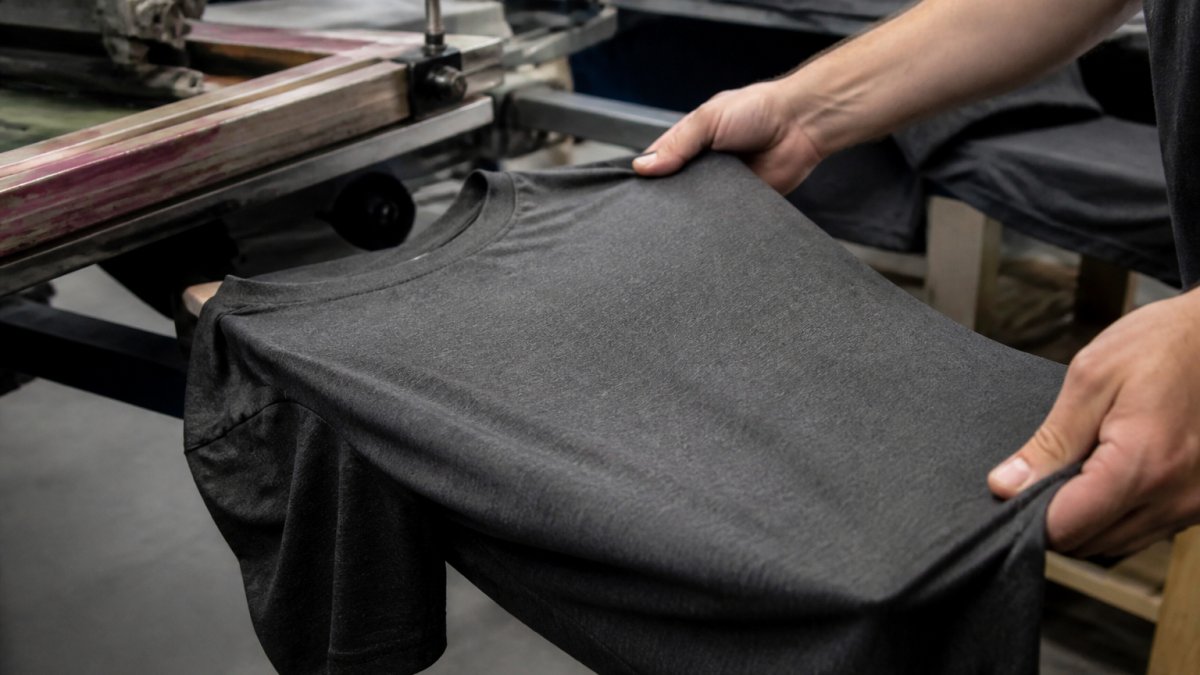
Quality control in printed apparel is the set of checks that catch a bad print, a shifted color, or a weak seam before the garment reaches a customer.
Moisture-wicking and breathable fabric matter for active wear; ring-spun cotton matters for softness and print clarity. Garment durability comes down to fiber quality and how the ink bonds to the fabric.
What to Look for in a Domestic Print Partner
Look for a partner who prints domestically, states the fabric content plainly, and stands behind the print through repeated washes. Ask three questions before you order:
- What fabric is used, and is the content listed?
- How is the print cured, and how does it hold up after washing?
- What is the reprint policy if a batch is defective?
FUR MISSILE prints on 100% ring-spun Gildan 64000 cotton, a soft, durable blank that holds a print through heavy wash cycles. Our Brittany Happy 250th America T-Shirt and Chocolate Lab Happy 250th America T-Shirt both use that fabric, with a unisex fit built for the field and the truck ride home. For handlers who want breed-specific gear, the American Hound Happy 250th America T-Shirt and Beagle Happy 250th America T-Shirt carry the same build.


Ask any print partner for a wash-test sample before a bulk run. A shirt that keeps its print after ten washes tells you more than any spec sheet.
Frequently Asked Questions
Is USA-printed apparel higher quality than imported alternatives?
Quality depends on the printer, not the country. Domestic print shops typically use plastisol or water-based inks cured at controlled temperatures, which reduces cracking and fading. You can also visit the shop or request samples before a bulk order. Imported garments often travel for weeks in humid containers, which can affect ink adhesion and fabric hand-feel. For hunting dog owners who wash gear constantly, domestic printing usually holds up better over repeated cycles.
How does domestic printing impact supply chain reliability?
Domestic printing shortens the supply chain to a few days or weeks instead of months. You avoid ocean shipping delays, port congestion, and customs holds that can push delivery past your event or season. If a design needs a correction, the reprint ships from a US facility in days. For custom apparel supply chain reliability, domestic production gives you a single point of contact and faster problem resolution.
What environmental advantages come with local apparel production?
Local production cuts the freight miles and emissions tied to ocean shipping. Domestic printers also face Clean Air Act and EPA rules on ink and solvent disposal, so waste handling is regulated. Many US shops now offer water-based inks and recycled fabric options. You can ask your printer for their ink type and waste process, which is harder to verify with an overseas supplier.
What should brands look for when vetting a domestic print shop?
Ask for the garment brand and style number, ink type, cure temperature, and a wash-test sample. Confirm turnaround time in writing and get a tracking process for every order. Check whether they print in-house or outsource. A shop that shares fabric specs and offers a sample run before bulk production gives you a clear picture of garment durability and print quality.
The challenge is simple: cheap apparel is easy to find, but apparel that arrives on time, fits right, and survives the field is not. FUR MISSILE builds bold, breed-specific gear on premium ring-spun cotton, printed domestically and shipped with tracking on every order. Shop FUR MISSILE and gear up for the next mission.