

Table of Contents
- Tactical Apparel vs Standard Police Uniform: What Actually Changes on Duty
- Law Enforcement Uniform Types: Class A, Class B, and Class C Explained
- Side-by-Side Comparison: Duty, Features, and Trade-Offs
- Tactical Clothing Features That Change How You Work
- Police Uniform Comfort and Mobility Across Long Shifts
- Choosing a High-Performance Police Uniform Shirt
- Agency Policy, Procurement, and Community Perception
- Conclusion
- Frequently Asked Questions
Last Updated: October 15, 2026
Tactical Apparel vs Standard Police Uniform: What Actually Changes on Duty
The tactical apparel vs standard police uniform debate comes down to one question: what does the job actually demand?
This guide breaks down law enforcement uniform types, the real trade-offs, and how to pick by assignment. Below, we cover what most uniform guides skip: policy, procurement, and how the public reads what you wear.
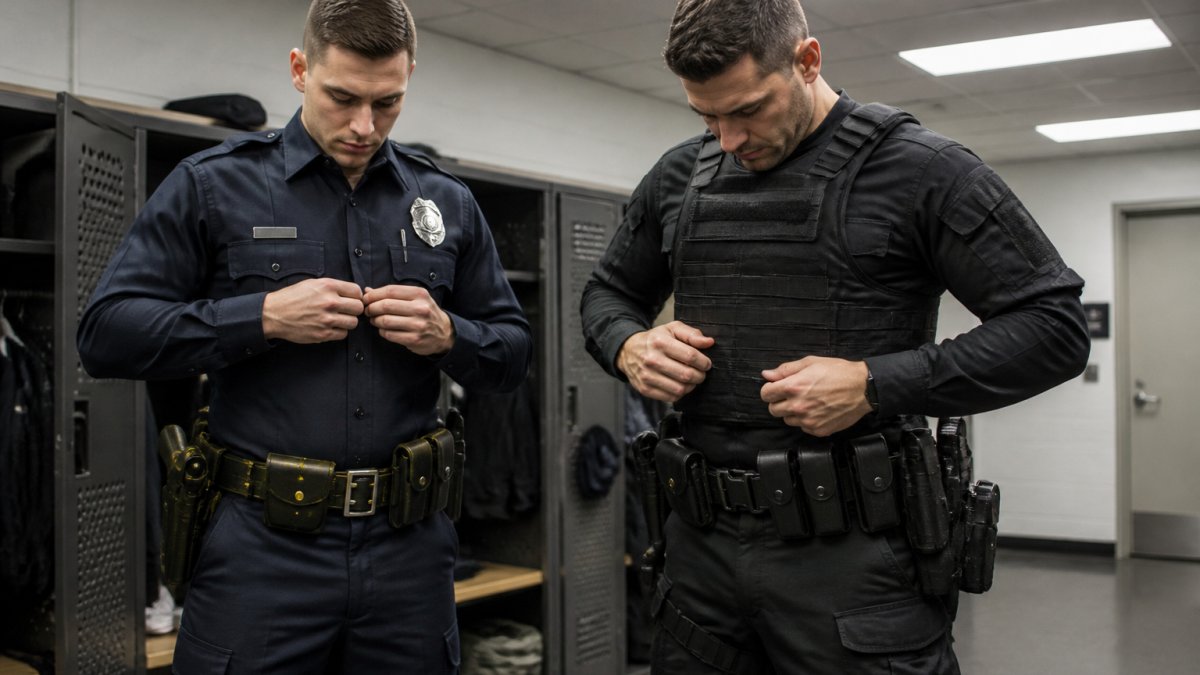
The short answer: neither option wins everywhere. Standard uniforms win on public-facing patrol and ceremonial wear. Tactical apparel wins on mobility, durability, and equipment compatibility. Match the garment to the assignment, not the trend.
Law Enforcement Uniform Types: Class A, Class B, and Class C Explained
Law enforcement uniform types fall into three classes, each matched to a different duty level. Class A is formal and ceremonial. Class B is the everyday patrol uniform. Class C is the functional, utility-focused option closest to tactical clothing.
That classification system is the backbone of every uniform policy. Here's how each one works.
Class A Uniforms for Ceremonial Wear
A Class A uniform is the dress version: pressed shirt, tie, jacket, and badge. Departments issue it for ceremonies, court appearances, and formal public events. It signals authority and tradition, and it is not built for a foot chase. The trade-off is clear: maximum professional appearance, minimum mobility.
Class B and Class C for Daily Patrol
A Class B uniform is the standard police uniform most patrol officers wear on daily patrol. It usually means a button-down or polo-style uniform shirt, a duty belt, and standard trousers.
Class C takes that further. It leans toward tactical clothing: ripstop fabrics, cargo pockets, and stretch panels. Many agencies now allow Class C for high-demand environments like specialized units or warmer months. The line between Class C and full tactical apparel is thin, and that's where the confusion starts.
Side-by-Side Comparison: Duty, Features, and Trade-Offs
Here's the honest comparison. Each option has a job it does well, and each one has a weakness you should know before you buy.
| Feature | Standard Police Uniform | Tactical Apparel | Hybrid Setup |
|---|---|---|---|
| Best for | Daily patrol, public contact, court | Specialized units, planned operations, high-risk warrants | Patrol officers who want durability without a full tactical look |
| Appearance | Formal, traditional | Functional, assertive | Standard shirt, tactical trouser |
| Mobility | Moderate | High | High in the lower body |
| Durability | Standard | Abrasion and tear resistant | Reinforced knees and seat |
| Storage | Limited pockets | Extra pockets, duty gear ready | Cargo pockets on trousers only |
| Community perception | Familiar, trusted | Can read as more aggressive | Mostly neutral |
| Typical cost posture | Lowest upfront | Highest upfront | Middle |
| Care burden | Simple laundering | Technical fabrics, slower drying | Mixed |
A common mistake is buying tactical apparel for a role that never needs it. If you work a public-facing beat, a standard police uniform usually serves you better. If you're in a high-demand environment, tactical wins on function.
Decision Framework by Assignment
Match the garment to the assignment, not the trend. Here is how most practitioners sort it out.
- Routine patrol and community engagement. Standard Class B. The familiar look supports routine contacts, and the lower upfront cost fits a replace-every-few-years cycle.
- Traffic and motor units. Standard Class B with a high-visibility outer layer where policy allows. Tactical trousers add little here; visibility and weather protection matter more.
- Planned operations and high-risk warrants. Tactical apparel. Reinforced knees, gusseted construction, and equipment-ready pockets earn their cost when the assignment is physical.
- K9 and working-dog handlers. Tactical or hybrid. Handlers spend time kneeling, running, and working in brush, so abrasion resistance and knee reinforcement pay off faster than on a foot beat.
- Ceremonial and court. Class A. No tactical substitute applies.
The Trade-Offs Nobody Lists
Every gain has a cost, and the cost is usually in care, cost, or perception rather than performance.
- Mobility vs. appearance. Stretch panels and articulated knees improve range of motion but read as more tactical. On a public-facing beat, that perception shift is the real price.
- Durability vs. care. Ripstop and stretch-woven fabrics resist tearing but dry slower and can pill if washed with heavy items. Follow the care label or you shorten the garment's life.
- Storage vs. silhouette. Extra pockets hold more gear but add bulk, which can interfere with a duty belt and a concealed carrier.
- Upfront cost vs. lifecycle cost. Tactical apparel usually costs more per unit but can outlast standard issue, so the cheaper garment is not always the cheaper choice over a replacement cycle.
Tactical Clothing Features That Change How You Work
Tactical clothing features are not marketing fluff. They change how the garment performs during a full shift.
The big ones:
- Reinforced knees for kneeling and ground contact
- Abrasion and tear resistance in ripstop or stretch-woven fabric
- Extra pockets for equipment storage and duty gear
- Moisture management to move sweat away from the body
- Gusseted construction for range of motion
Each feature solves a specific problem. Reinforced knees matter if you're kneeling on asphalt. Moisture management matters if you work long shifts in heat. The trick is buying only the features your assignment actually uses.
Police Uniform Comfort and Mobility Across Long Shifts
Police uniform comfort comes down to fit, fabric, and footwear. A uniform that restricts your range of motion wears you down by hour eight.
Fit matters more than fabric here. A shirt that binds at the shoulders limits your reach. Pants that sit wrong limit your stride. For long shifts, prioritize:
- A uniform shirt cut for shoulder movement
- Pants with a gusseted crotch and stretch panels
- Sneaker-type footwear where policy allows it
- Breathable fabric for moisture management
The footwear point is underrated. Many agencies now permit sneaker-type footwear on patrol because foot health affects the whole shift. Comfort is not softness. It is reliability across a long day.
Choosing a High-Performance Police Uniform Shirt
A high-performance police uniform shirt balances breathability, durability, and professional appearance. It should look sharp at roll call and still breathe at hour ten.
What most guides miss: the shirt is where the trade-off between tactical function and public perception lives. A crisp standard uniform shirt reads as approachable. A tactical shirt reads as ready for action. Both are correct, just for different settings.
When you shop, check these:
- Fabric weight and breathability
- Moisture management
- Reinforced stitching at stress points
- Fit across the shoulders and chest
- Color and class compliance with your policy
If you want gear that holds up to repeated wash cycles and field wear, look for durable construction and reinforced seams. That is the same standard we hold our own apparel to at FUR MISSILE, where every piece is built to survive the mission and keep its shape over time.
Agency Policy, Procurement, and Community Perception
Agency policy decides what you can wear, and it usually follows a formal procurement process. That process weighs cost, standards, and safety, not just looks. Most competitors stop at "check your policy." Here is what the policy actually governs and how the money works.
What Uniform Policy Actually Controls
A written uniform policy typically defines four things:
- Authorized classes. Which of Class A, B, or C is approved for which duty, and whether a tactical or hybrid option is permitted at all.
- Color and insignia. Shirt and trouser color, badge placement, name tape, and unit patches. These are the details that make a garment compliant or not.
- Equipment compatibility. How the uniform interfaces with a duty belt, an external carrier, or a concealed vest.
- Replacement cycle. How often items are issued or reimbursed, and whether officers buy their own.
If your agency does not publish a clear class list, ask before you buy. A garment that fails the class check is money spent twice.
Body Armor and Equipment Compatibility
This is the gap most guides miss. A uniform is not protective equipment, and it is not certified as such. Body armor is. The National Institute of Justice armor standards set the protection levels your vest and carrier must meet, and your uniform has to work with that soft armor, not against it.
In practice, that means three compatibility questions:
- External carrier or concealed? An external carrier changes the shirt cut you need. A uniform shirt sized for a concealed vest will bind over an external carrier.
- Duty belt interface. Belt loops, waistband height, and shirt length determine whether your gear stays put during movement.
- Layering. Cold-weather layers must fit under or over the carrier without shifting it.
Clothing features like moisture management and reinforced knees are performance benefits, not safety certifications. Do not confuse the two when you read a product page.
Total Cost of Ownership Over a Replacement Cycle
Procurement weighs more than sticker price. A useful way to compare is cost per year of service, not cost per unit.
- Upfront cost. Standard issue is usually the lowest per unit. Tactical apparel is the highest.
- Replacement frequency. A garment that fades, tears, or loses shape in a year costs more per year than a durable one bought once.
- Maintenance. Technical fabrics may need cooler wash cycles and air drying, which adds time and wear.
- Alterations and fit. Ill-fitting gear gets replaced early. Fit is a cost line, not a comfort line.
A common pattern is that agencies trial a hybrid setup on one unit before a department-wide change, because it limits both cost and perception risk.
Community Perception and De-Escalation
The President's Task Force on 21st Century Policing report tied officer appearance and procedural justice to public trust, and how a uniform reads is part of that. Research from the National Institute of Justice on officer safety and equipment also shows that gear choices affect both officer safety and how encounters unfold.
The practical takeaway is not that tactical is bad. It is that appearance is a variable you can manage. A familiar standard uniform can lower tension in a routine contact. A tactical look can be appropriate when the assignment itself signals risk.
Conclusion
The right choice depends on your assignment, your agency policy, and how the public will read you. Standard uniforms win on daily patrol and community trust. Tactical apparel wins on mobility, durability, and equipment storage. Get the match right and the gear stops fighting you.
At FUR MISSILE, we build bold, high-performance apparel for hunting dog lovers and pet enthusiasts. Our gear uses premium materials, holds its shape through repeated wash cycles, and ships worldwide with tracking on every order. Shop FUR MISSILE and gear up for the mission.
Frequently Asked Questions
What is the difference between tactical apparel and a standard police uniform?
A standard police uniform follows a department's Class A, B, or C dress code, prioritizing a professional appearance for daily patrol and ceremonial wear. Tactical apparel is built around function: ripstop fabric, gusseted knees, extra pockets, and moisture management for high-demand environments. Many agencies now approve tactical-style uniforms for patrol, so the line between the two often comes down to policy rather than design.
Is tactical clothing more durable than a standard police uniform?
It depends on the fabric, not the label. Tactical pants and shirts typically use ripstop nylon-cotton blends with reinforced knees and bar-tacked stress points, which resist abrasion and tearing better than traditional polyester-wool dress uniforms. Standard uniforms hold up fine for administrative or ceremonial wear. For officers crawling through brush, vaulting fences, or training in a high-demand environment, tactical construction usually outlasts a dress-style uniform.
When should officers wear tactical apparel instead of a standard uniform?
Wear tactical apparel for tactical response, K9 handling, firearms training, and any assignment where range of motion and equipment storage matter more than a pressed appearance. Keep the standard uniform for court, community events, and routine patrol where professional appearance supports community perception. Most agencies spell this out in policy, so check your department's uniform directive before mixing pieces.
What features should you look for in a high-performance police uniform shirt?
Look for moisture-wicking fabric, a gusseted underarm for range of motion, and a cut that stays tucked under a protective vest. A high-performance police uniform shirt should also have mic loops, badge tabs, and pen pockets placed so they do not interfere with body armor or a duty belt. Fit matters as much as fabric: a shirt that binds at the shoulder will fail you during a foot pursuit.